
THE TRUST ECONOMY
Why AI Alone Cannot Create Trusted Intelligence
EXECUTIVE SUMMARY
Artificial intelligence is becoming ubiquitous. Trust is not.
Across industries, organizations are deploying increasingly capable models, agents, copilots, predictive systems, and automated decision tools. AI can now produce analysis, recommendations, forecasts, content, code, and simulations at a speed and scale that would have been unimaginable only a few years ago.
Yet a paradox is emerging. The more intelligence machines can generate, the harder it becomes to know which intelligence deserves to be believed.
This is the defining problem of the next phase of AI adoption.
For the first era of enterprise AI, competitive advantage came from access: access to data, computing power, models, and technical talent. The next era will be different. As powerful AI becomes widely available, access itself becomes less differentiating. The scarce resource becomes confidence: confidence in the evidence, the reasoning, the safeguards, the people exercising judgment, and ultimately the decision.
This paper calls that emerging environment the Trust Economy.
The Trust Economy is not an argument against AI. It is an argument for recognizing what makes AI economically useful. Intelligence has value only when people are willing to act on it. And action requires trust.
The central proposition is simple:
Trust is the Compound Interest of Intelligence™
A single accurate answer may create utility. Repeated, explainable, responsible, well-governed intelligence creates confidence. Confidence encourages greater use. Greater use creates more evidence and feedback. Better evidence improves future intelligence. When that cycle works, trust compounds.
When it fails, the opposite happens just as quickly.
The organizations that thrive in the next era will therefore not necessarily be those with the most powerful AI. They will be those that are best able to convert machine intelligence into trusted human decisions.
THE COST OF INTELLIGENCE IS COLLAPSING
For most of human history, producing useful intelligence was expensive.
Expertise took years to develop. Analysis required specialized teams. Research took time. Sophisticated modeling required scarce technical skills and significant computing resources.
AI is changing those economics.
An executive can now ask a system to analyze thousands of documents, compare strategic alternatives, identify patterns, construct scenarios, summarize competing arguments, and draft a recommendation in minutes. Organizations can deploy agents that monitor information continuously and act across workflows.
This does not make intelligence worthless. It changes where value resides.
When everyone can generate an answer, the answer itself becomes less scarce. The differentiating questions become: Where did it come from? What evidence supports it? What assumptions shaped it? What could be wrong? Who is accountable if we act on it?
The transition resembles earlier technology shifts. Computing power became cheaper, so advantage moved toward software. Software became widely accessible, so advantage moved toward data and workflow. As AI capability becomes widely available, competitive advantage is shifting again. It is moving toward trust.
It is moving toward trust.
Stanford's 2026 AI Index captures part of this tension. AI capabilities and deployments continue to advance, while responsible-AI measurement has not kept pace. The report also notes rising documented AI incidents and continued gaps in responsible-AI implementation. 1
That gap between capability and confidence is where the Trust Economy emerges.
THE TRUST GAP
Organizations often treat AI trust as a technical problem: improve accuracy, reduce hallucinations, strengthen cybersecurity, and the problem is solved.
Those things matter. But trust is broader than technical performance.
A model can be statistically impressive and still be unsuitable for a particular decision. An output can be accurate but based on stale evidence. A recommendation can be logically coherent while ignoring an ethical constraint, an organizational reality, or a low-probability risk with catastrophic consequences.
Trust is therefore contextual.
The question is not simply, “Is this AI good?”
The question is, “Is this intelligence sufficiently reliable, explainable, appropriate, and accountable for the decision we are about to make?”
That distinction becomes critical as AI moves from low-consequence assistance into high-consequence decisions involving capital, employment, customers, health, safety, reputation, public policy, and strategy.
NIST's AI Risk Management Framework reflects this multidimensional view. It treats trustworthy AI as involving characteristics including validity and reliability, safety, security and resilience, accountability and transparency, explainability and interpretability, privacy, and fairness. 2
Trust cannot be bolted onto an AI system after the model produces an answer. It must be designed into the entire decision architecture.
THE AI TRUST PYRAMID™
The AI Trust Pyramid™ provides a simple way to think about that architecture: AI Capability → Evidence Quality → Explainability → Human Judgment → Decision Confidence.
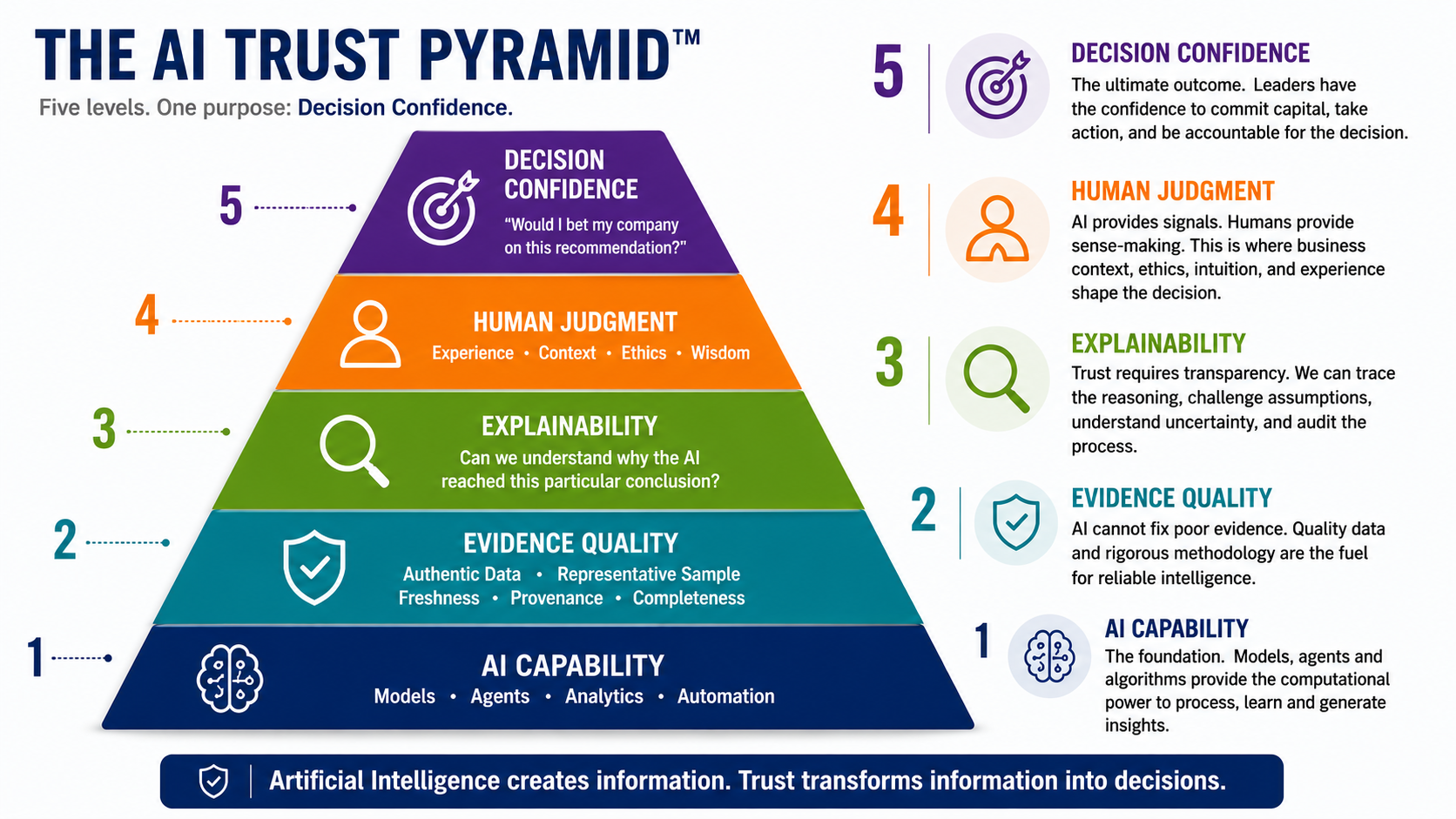
The ordering matters.
Organizations often assume that greater AI capability will automatically produce greater value. It does not.
Capability without quality evidence can produce sophisticated error.
Quality evidence without explainability can produce an answer that leaders are unwilling to trust.
Explainability without human judgment can produce technically defensible recommendations that fail in context.
Only when these layers work together do organizations reach the real objective: decision confidence.
Artificial Intelligence creates information.
Trust transforms information into decisions.
EVIDENCE BECOMES MORE VALUABLE IN AN AGE OF SYNTHESIS
Generative AI creates a second paradox: as synthetic information becomes easier to produce, authentic evidence becomes more valuable.
Text can be generated. Images can be generated. Voices can be cloned. Personas can be simulated. Data can be synthesized. Entire conversations can be created at negligible marginal cost.
This changes the economics of evidence.
In the pre-generative world, the existence of a polished document, detailed analysis, realistic image, or coherent narrative carried some implicit signal of effort and provenance. That signal is weakening.
Organizations will increasingly need to distinguish between information that merely looks persuasive and evidence that can be traced, validated, and defended.
NIST has separately addressed the risks of synthetic content, including methods for authentication, provenance, labeling, watermarking, and metadata.3 These mechanisms are important, but the larger enterprise implication goes beyond content authenticity.
Provenance becomes a strategic capability.
For consequential AI-supported decisions, organizations will need to know not only what the system concluded, but what evidence entered the system, what was generated, what was retrieved, what was inferred, what was excluded, and what remains uncertain.
In the Trust Economy, provenance is not administrative overhead.
It is part of the product.
EXPLAINABILITY MOVES FROM COMPLIANCE TO COMMERCE
Explainability is often framed as a regulatory or technical requirement.
That understates its commercial importance.
Executives do not act merely because a system is intelligent. They act when they understand enough about a recommendation to accept the risk of being wrong.
The required level of explanation will vary. A recommendation for the wording of a marketing email does not require the same scrutiny as a decision to approve a loan, change a clinical pathway, acquire a company, restructure a workforce, or enter a new country.
The principle is proportionality: the greater the consequence, irreversibility, uncertainty, or external impact of a decision, the higher the burden of explanation.
Explainability therefore becomes part of the infrastructure of trust.
It shortens the distance between analysis and action.
It allows boards to govern.
It allows executives to challenge.
It allows regulators and auditors to inspect.
It allows employees and customers to understand.
Most importantly, it creates the conditions under which responsibility can remain human even when intelligence is increasingly machine-generated.
HUMAN JUDGMENT BECOMES MORE, NOT LESS, IMPORTANT
The rise of AI has produced a misleading binary: either humans make decisions or machines do.
The more useful model is augmentation.
AI is exceptionally good at processing volume, detecting patterns, comparing alternatives, generating possibilities, and operating at machine speed. Humans bring a different set of capabilities: understanding context, exercising judgment, drawing on lived experience, applying values, using intuition and empathy, imagining possibilities, accepting accountability, and recognizing when the problem itself has been framed incorrectly.
The most valuable human contribution may increasingly be knowing when not to accept the machine's recommendation.
That is not an anti-technology position. It is precisely what makes powerful technology usable in complex environments.
As AI capability rises, organizations should not ask how to remove humans from every decision. They should ask where human judgment creates the greatest incremental value.
Routine, reversible, low-consequence decisions may become highly automated.
Ambiguous, novel, consequential, or values-laden decisions will require stronger human involvement.
The future organization will therefore need a deliberate architecture for human judgment rather than an improvised “human in the loop.”
Humans should not merely be the final click before an automated decision is executed.
Humans must have the authority, information, competence, and time to challenge the system.
GOVERNANCE MUST MOVE AT THE SPEED OF AI
Traditional governance was designed for systems that changed relatively slowly.
AI does not.
Models are updated. Data changes. Prompts change. Agents gain new tools. Workflows become more autonomous. New use cases emerge from employees before central governance teams know they exist.
This creates a governance challenge: control mechanisms that are too slow will be bypassed, while controls that are too restrictive will suppress useful innovation.
The answer is not more bureaucracy. It is better architecture.
NIST's AI RMF organizes risk management around four functions: Govern, Map, Measure, and Manage.2 That is useful because it treats governance as a continuous operating discipline rather than a one-time approval.
Organizations need clear decision rights. Which uses of AI can be autonomous? Which require review? Which evidence standards apply? When must an output be explainable? Who can override a model? What must be logged? What happens when the system is wrong?
These questions should be answered before the crisis, not during it.
The strongest AI governance will increasingly resemble good enterprise governance: clear principles, distributed accountability, proportionate controls, transparent escalation, and continuous learning.
THE TRUST FLYWHEEL™
Trust is not a one-time achievement. It is a continuous cycle.
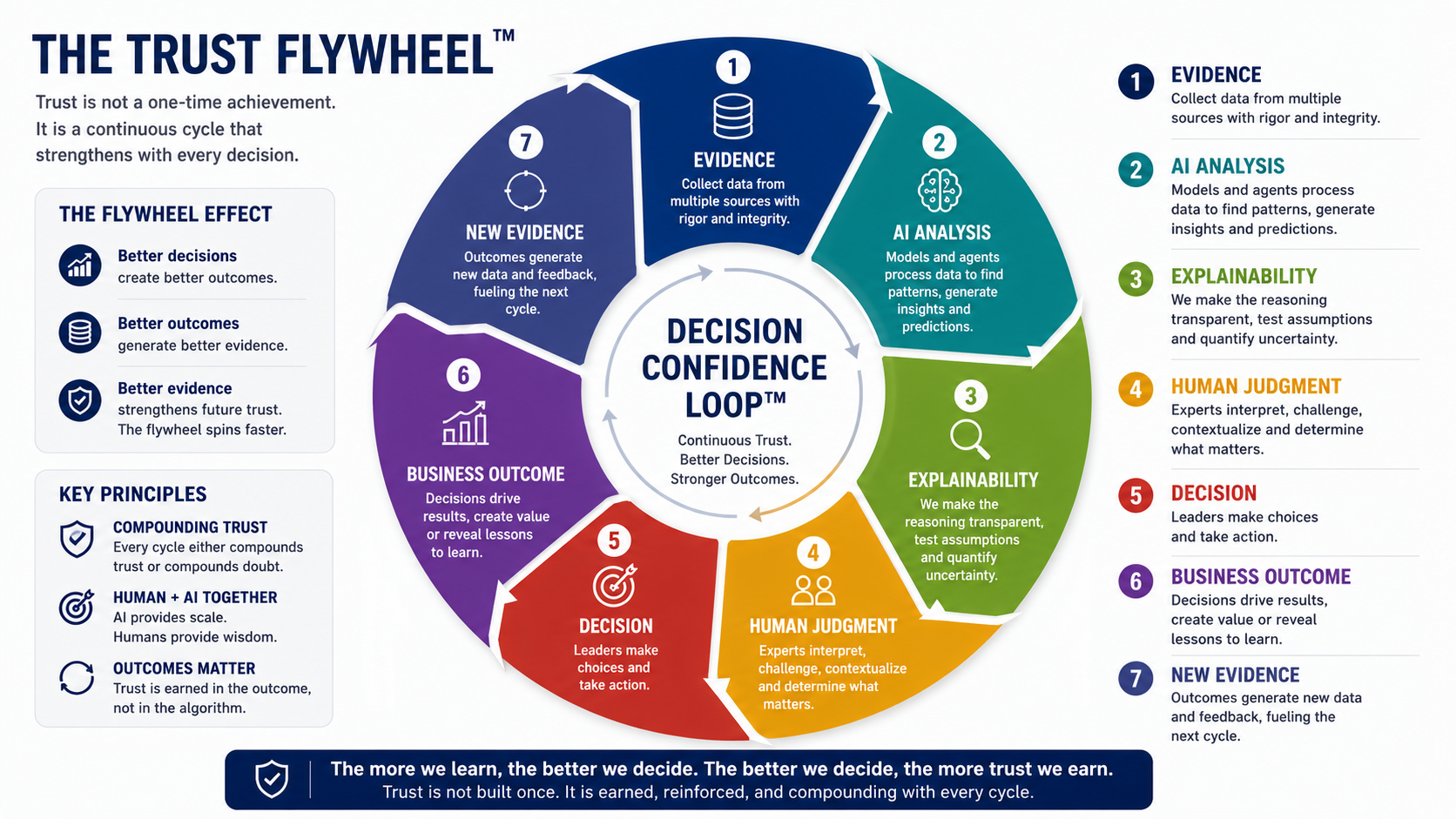
The Trust Flywheel™ describes a continuous cycle: Evidence → AI Analysis → Explainability → Human Judgment → Decision → Business Outcome → New Evidence.
The important insight is that the cycle can move in either direction.
When AI produces sound recommendations, when humans apply good judgment, and when outcomes validate the decision, trust increases. Increased trust encourages broader responsible use. Broader use creates more evidence. More evidence can improve future intelligence.
Trust compounds.
But doubts compound too.
An unexplained recommendation, a hidden bias, a fabricated source, a privacy failure, or a highly visible bad decision can destroy confidence built over years.
The flywheel therefore has a governing principle:
Each cycle either compounds trust or compounds doubt.
This is why trust should be managed as an economic asset rather than treated as a communications objective.
TRUST BECOMES AN ECONOMIC ASSET
Trust has economic value.
It affects adoption.
It affects how quickly employees use AI.
It affects whether customers accept AI-mediated interactions.
It affects whether boards approve AI-enabled strategies.
It affects regulatory confidence.
It affects whether partners share data.
It affects whether executives are willing to act on machine-generated recommendations.
In economic terms, trust reduces friction.
Low-trust environments require more checking, more approvals, more duplication, more legal review, more human intervention, and larger margins of safety.
High-trust environments can move faster. But high trust must be earned, not assumed.
This is why “trust us” is not a trust strategy.
Organizations must be able to demonstrate why confidence is warranted.
FROM AI ROI TO DECISION ROI
Organizations frequently evaluate AI through conventional measures: cost reduction, productivity, automation, headcount leverage, response time, and throughput.
Those measures are necessary but incomplete.
The more strategic question is whether AI improves the quality and speed of consequential decisions.
Did the organization identify the risk earlier?
Did it allocate capital better?
Did it understand the customer more accurately?
Did it avoid a bad acquisition?
Did it detect fraud sooner?
Did it improve a clinical, operational, or strategic outcome?
Did it recognize uncertainty before committing?
This shifts the conversation from AI ROI to Decision ROI.
An AI system that saves thousands of employee hours but causes one catastrophic decision may have negative strategic value.
Conversely, a system used only occasionally may be extraordinarily valuable if it materially improves a handful of high-stakes decisions.
The unit of value should therefore move from “AI output” toward “decision outcome.”
That shift will also change how organizations design AI systems. Instead of beginning with the question, “Where can we use AI?” they will begin with, “Which decisions matter most, and how can better intelligence improve them?”
COMPETITIVE ADVANTAGE IN THE TRUST ECONOMY
As advanced AI models become widely available, access to them alone will become an increasingly weak source of competitive advantage.
The sources of competitive advantage will increasingly be those that are harder to copy.
Trusted data.
Institutional knowledge.
Transparent reasoning.
Domain expertise.
Governance.
Human judgment.
Customer confidence.
A record of responsible outcomes.
These assets accumulate over time. That is why trust compounds.
A competitor could license the same model tomorrow. It cannot instantly replicate years of trusted decisions, proprietary evidence, institutional learning, customer relationships, and demonstrated judgment.
The strategic implication is significant.
Organizations should stop treating trust as the brake on AI adoption. Properly designed, trust is the accelerator. It is what allows AI to move from experimentation to deployment, from deployment to reliance, and from reliance to strategic advantage.
CONCLUSION: TRUST IS THE COMPOUND INTEREST OF INTELLIGENCE™
The current AI revolution began with capability.
Could machines understand language?
Could they generate images?
Could they write software?
Could they reason?
Could they act autonomously?
Those questions mattered because they established what was technologically possible.
The next chapter asks a harder question:
What intelligence are we willing to trust?
That question cannot be answered by a benchmark alone.
It requires evidence quality.
It requires explainability.
It requires governance.
It requires human judgment.
It requires accountability.
And ultimately, it requires outcomes that justify confidence.
Artificial intelligence will continue to become faster, cheaper, more capable, and more pervasive. That trajectory makes trust more important, not less.
When intelligence is scarce, access creates advantage. When intelligence is abundant, confidence creates advantage.
The organizations that understand this will build more than AI systems. They will build trusted decision systems.
And every time those systems produce sound decisions, learn from outcomes, and improve future intelligence, something valuable happens.
Trust compounds.
Trust is the Compound Interest of Intelligence™
SOURCES & NOTES
[1] Stanford Institute for Human-Centered Artificial Intelligence (Stanford HAI), The 2026 AI Index Report, “Responsible AI.” The report notes that responsible-AI benchmarking is not keeping pace with AI advances and deployments; documented AI incidents rose in 2025; and organizations continue to face knowledge, budget, and regulatory barriers to responsible-AI implementation.
[2] National Institute of Standards and Technology (NIST), U.S. Department of Commerce, Artificial Intelligence Risk Management Framework (AI RMF 1.0). NIST identifies multiple characteristics of trustworthy AI and organizes AI risk management around four functions: Govern, Map, Measure, and Manage.
[3] National Institute of Standards and Technology (NIST), U.S. Department of Commerce, Reducing Risks Posed by Synthetic Content (NIST AI 100-4), April 2024. The report examines approaches to detecting, authenticating, and labeling synthetic content, including digital watermarking, metadata, and provenance.
[4] National Institute of Standards and Technology (NIST), U.S. Department of Commerce, Artificial Intelligence Risk Management Framework: Generative Artificial Intelligence Profile (NIST AI 600-1), July 2024. A cross-sectoral companion to the AI RMF addressing risks that are unique to or exacerbated by generative AI.