
Computers and Human Safety
Seeing the potential of software and artificial intelligence to improve industrial safety
India's technology opportunity was emerging. So was a larger question: how could computing be used not simply to increase productivity, but to protect human life?
A 1988 perspective on India's potential to become a global software leader, the growing challenge of industrial safety, and the early application of computer systems and artificial intelligence to risk management.
Context
Before India's software future became obvious
In 1988, India's emergence as a global technology power was far from established. Yet the country's combination of skilled technical talent and the labor-intensive nature of software development suggested a very different future.
In this article for The Times of India Independence Day issue, I argued that India was positioned to achieve international leadership in software and could emerge as a world leader in the following decade and into the 21st century.
But the article was principally about another challenge: industrial safety.
Against the backdrop of Bhopal and other major disasters, I examined how computers could be applied to accident prevention, risk and hazard assessment, disaster management and safety management.
The article also described SAM, a computer-based safety management system developed by MARRS, and work then beginning to apply artificial intelligence to human and environmental safety.
The article is reproduced below as published on August 15, 1988.
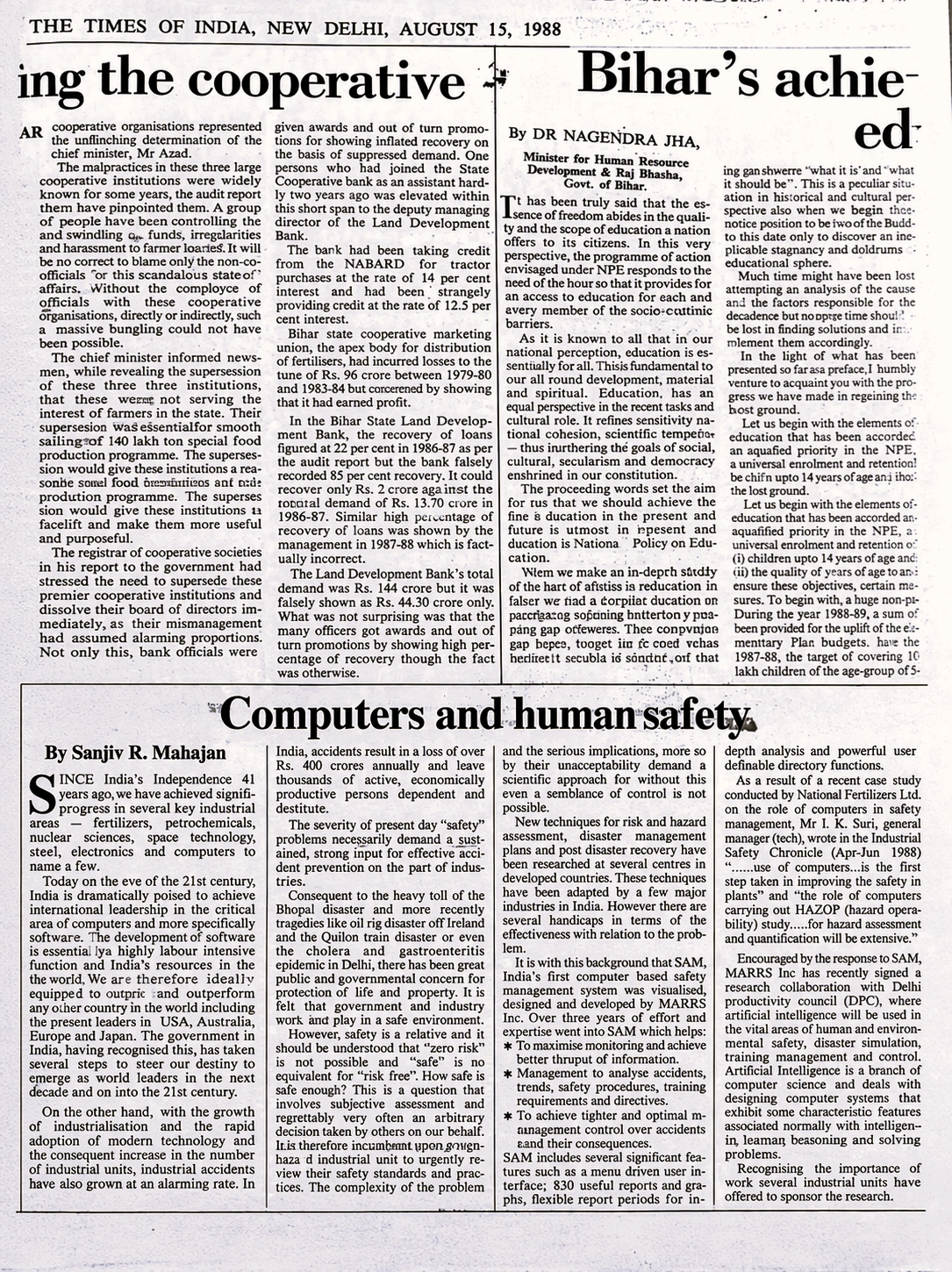
Copyright in the original publication remains with the respective rights holder(s)
Retrospective
The argument in 1988
India could become a global software leader. The country's skilled technical workforce and the economics of software development created the conditions for international leadership.
Computing could do more than improve productivity. Computer systems could be applied to industrial safety, accident prevention, risk assessment and disaster management.
Safety required better intelligence. High-risk environments needed systematic monitoring, analysis and management rather than relying principally on subjective judgment.
Artificial intelligence had applications beyond computing itself. The article described work using AI in human and environmental safety, disaster simulation, training, management and control.
Nearly four decades later
The question remains
The technologies have changed dramatically. The underlying question has not.
In 1988, the issue was how computing and emerging artificial intelligence could augment human capability in environments where errors could have serious consequences.
Today, AI can analyze vastly larger amounts of information, identify patterns, simulate outcomes and increasingly recommend or execute decisions. The capabilities are radically different, but the fundamental challenge remains: how should we combine machine intelligence with human judgment when the consequences matter?
“The more powerful the technology becomes, the more important the quality of the decisions made with it.”
How do we use increasingly powerful intelligence not simply to automate more, but to make better decisions and improve human outcomes?