
U.S. Recession is over
Calling the turn and advising businesses to act before the recovery became obvious
The Call
A turning point before the consensus
AM&G's early April 2002 analysis concluded that the U.S. recession had ended in March and that the economy was entering a period of recovery.
The analysis recognized an important distinction between an economic turning point and the point at which that change becomes generally apparent. AM&G expected the upswing to become visible only after another three to four months.
That lag created the opportunity.
Rather than waiting for confirmation from the broader market, businesses could begin positioning themselves for the recovery while competitors were still responding to the conditions of the downturn.
On April 8, 2002, The Hindu reported the call and the strategic advice behind it, identifying Sanjiv R. Mahajan as Managing Partner of the U.S.-based management consulting firm.
The Analysis
What the evidence was showing
The conclusion drew on historical recession data together with emerging economic and technology indicators.
AM&G examined the duration of U.S. recessions since 1945 and estimated that the downturn beginning in March 2001 had lasted approximately 11.4 months. The analysis argued that recognition of the end of a recession, like recognition of its beginning, necessarily follows the underlying economic change.
Several indicators suggested that change was already underway.
A Morgan Stanley survey of 225 Chief Information Officers found that more than two-thirds were optimistic about the U.S. economic outlook. Morgan Stanley analysts believed the worst was over and expected conditions to improve gradually during 2002.
The InformationWeek IT Confidence Index had also risen 46 percent in March, reaching its highest level in nine months.
AM&G's assessment was that technology, whose contraction had contributed significantly to the downturn, could now become an important force in the recovery.
The Strategic Advice
Don't wait for the recovery to become obvious
AM&G's advice followed directly from the analysis.
If the recession had ended but widespread recognition would lag by three to four months, companies had a limited period in which to make decisions before improving conditions were reflected in broader business behavior.
The recommendation was therefore to begin investing rather than remain in defensive mode.
AM&G argued that companies willing to act during this period could strengthen their competitive position while others continued to postpone spending.
“Smart businesses will leverage this lag … to grab competitive advantage.”
This was not simply a prediction about where the economy was heading. It was strategic advice derived from that prediction: recognize the turn, understand the lag and use it to act before competitors do.
Why Technology Mattered
From cause of the downturn to engine of recovery
Technology spending was central to the argument.
AM&G pointed to projected U.S. federal IT spending of approximately $45 billion in 2002 and $52 billion in 2003, particularly in areas associated with national security, homeland security and other government priorities.
The analysis also identified increased investment by individual states, the Invest in America initiative involving more than 300 national organizations, and economic-stimulus measures intended to strengthen consumer and corporate confidence.
Taken together with improving CIO sentiment and the sharp rise in the IT Confidence Index, these developments supported AM&G's view that technology could help drive the next phase of economic growth.
Independent Press Coverage
The Hindu reports the call and the advice
On April 8, 2002, The Hindu reported AM&G's assessment under the headline “U.S. recession is over.”
The newspaper identified Sanjiv R. Mahajan as Managing Partner of the U.S.-based management consulting firm and reported both elements of AM&G's position: that the recession had ended and that businesses should move before the expected recovery became apparent.
That distinction matters. The prediction established a view of what was happening. The advice translated that view into a business decision.
The Hindu also reported that an Associated Press analysis from Washington was pointing toward a similar recovery scenario, while noting geopolitical instability and possible disruption to oil supplies as risks to the outlook.
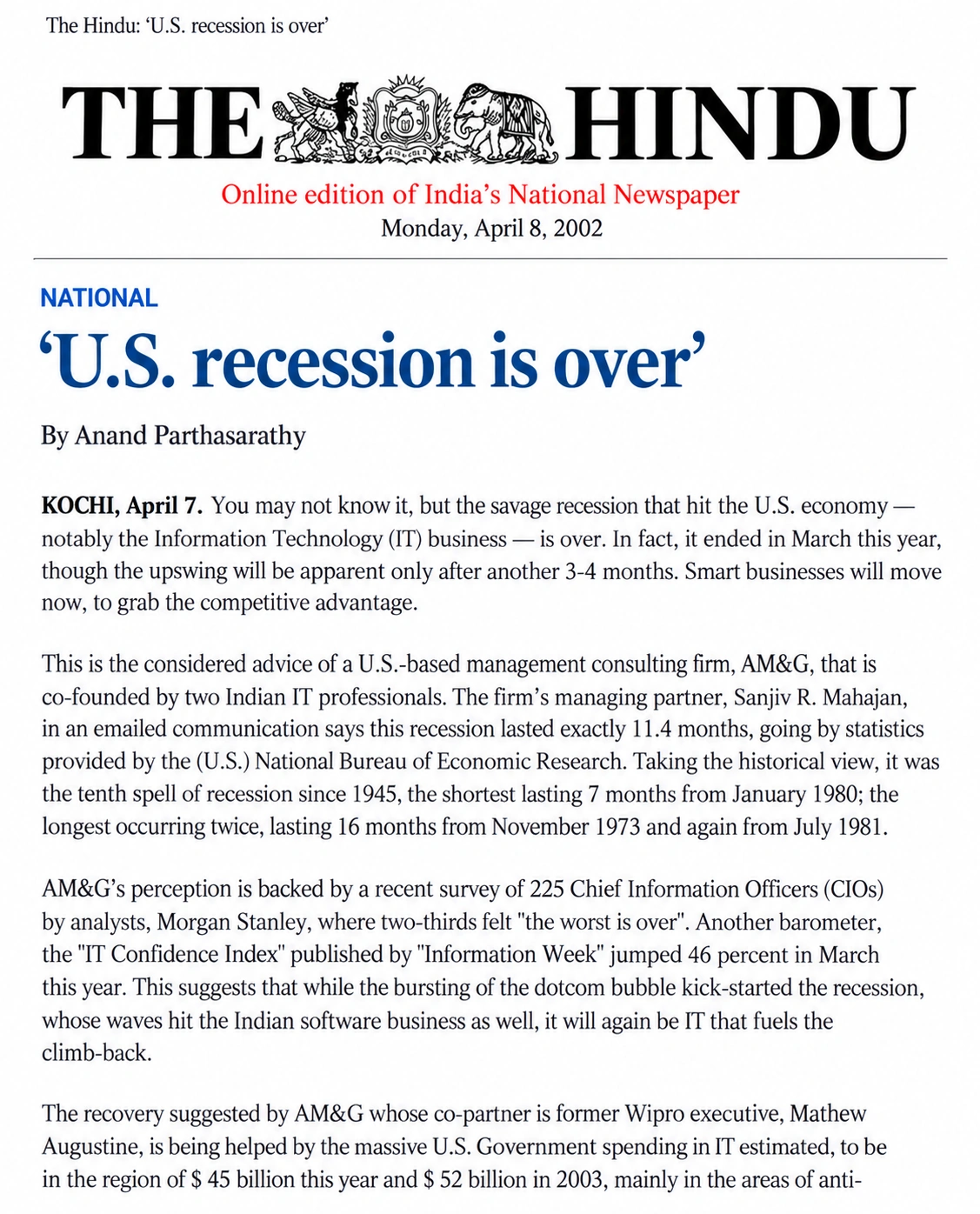
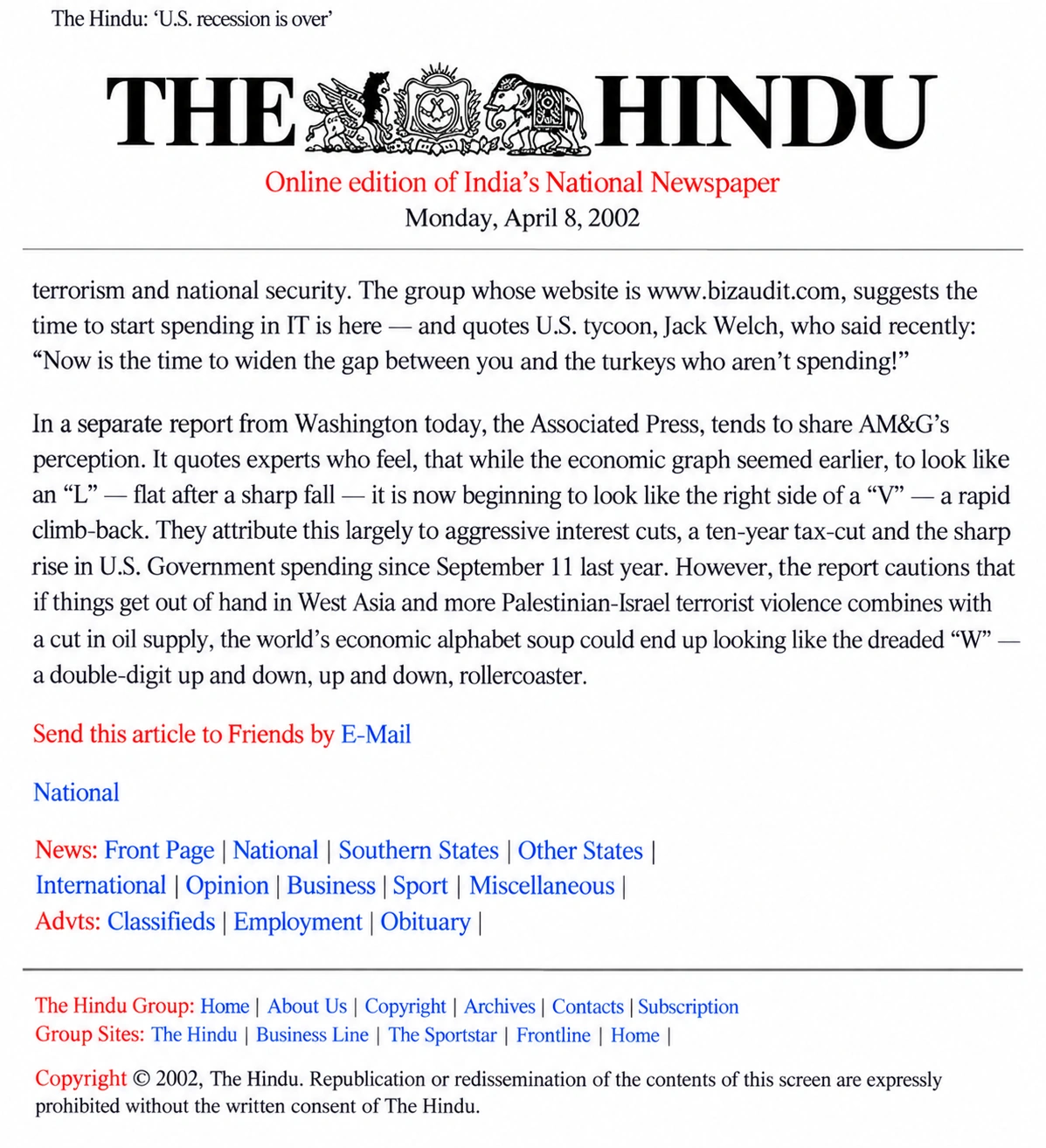
The Hindu pages are reproduced here as an archival record. Copyright in the original publication and reproduced pages remains with the respective rights holder(s).
The Original Analysis
AM&G Perspective · April 2002
The underlying analysis was published in AM&G Perspective, April 2002, Issue 1, under the headline “NEWS: The US Recession is over!”
The two-page publication documented both the economic call and the strategic recommendation behind it: the historical recession analysis, the expected three-to-four-month recognition lag, CIO confidence, government technology spending and the case for businesses to begin investing ahead of the broader recovery.
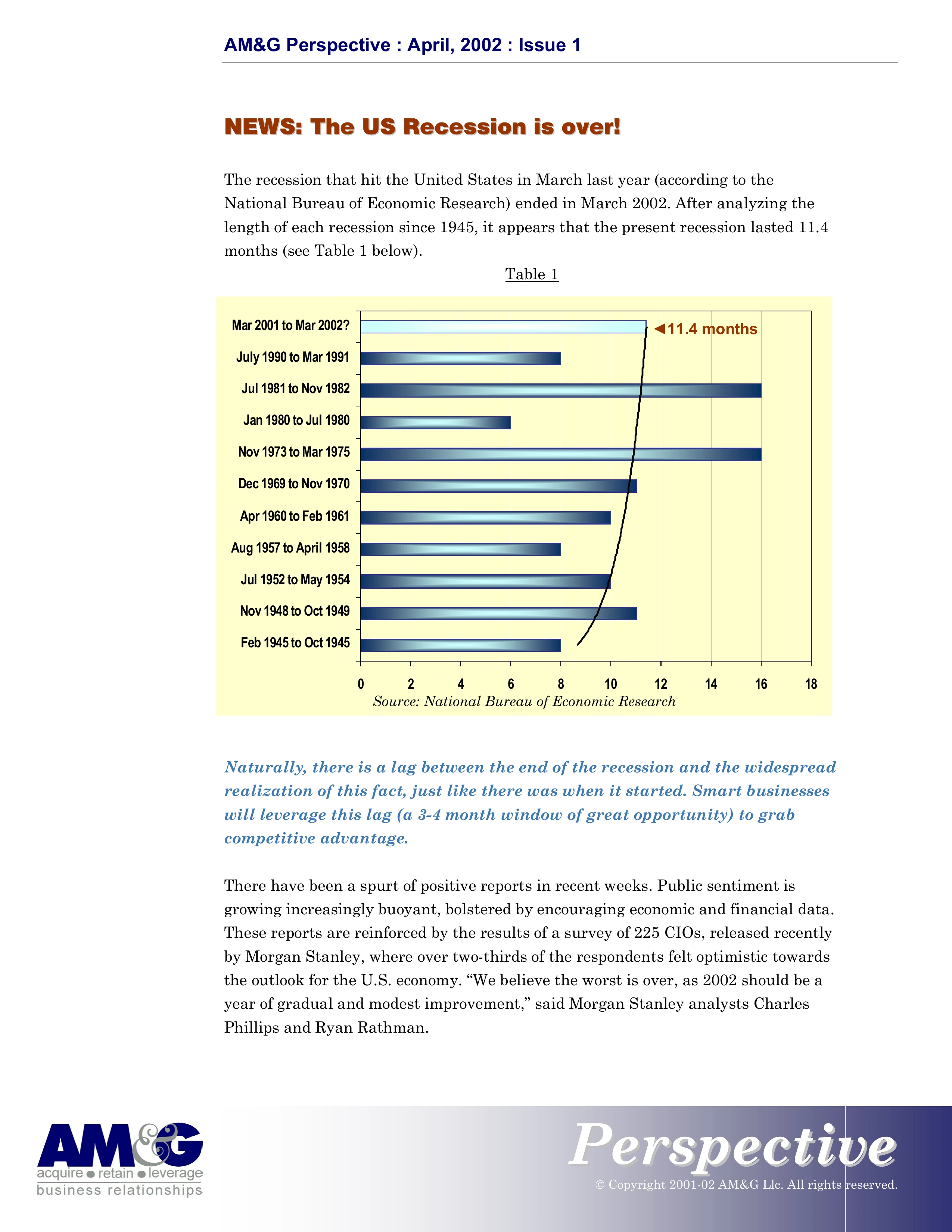
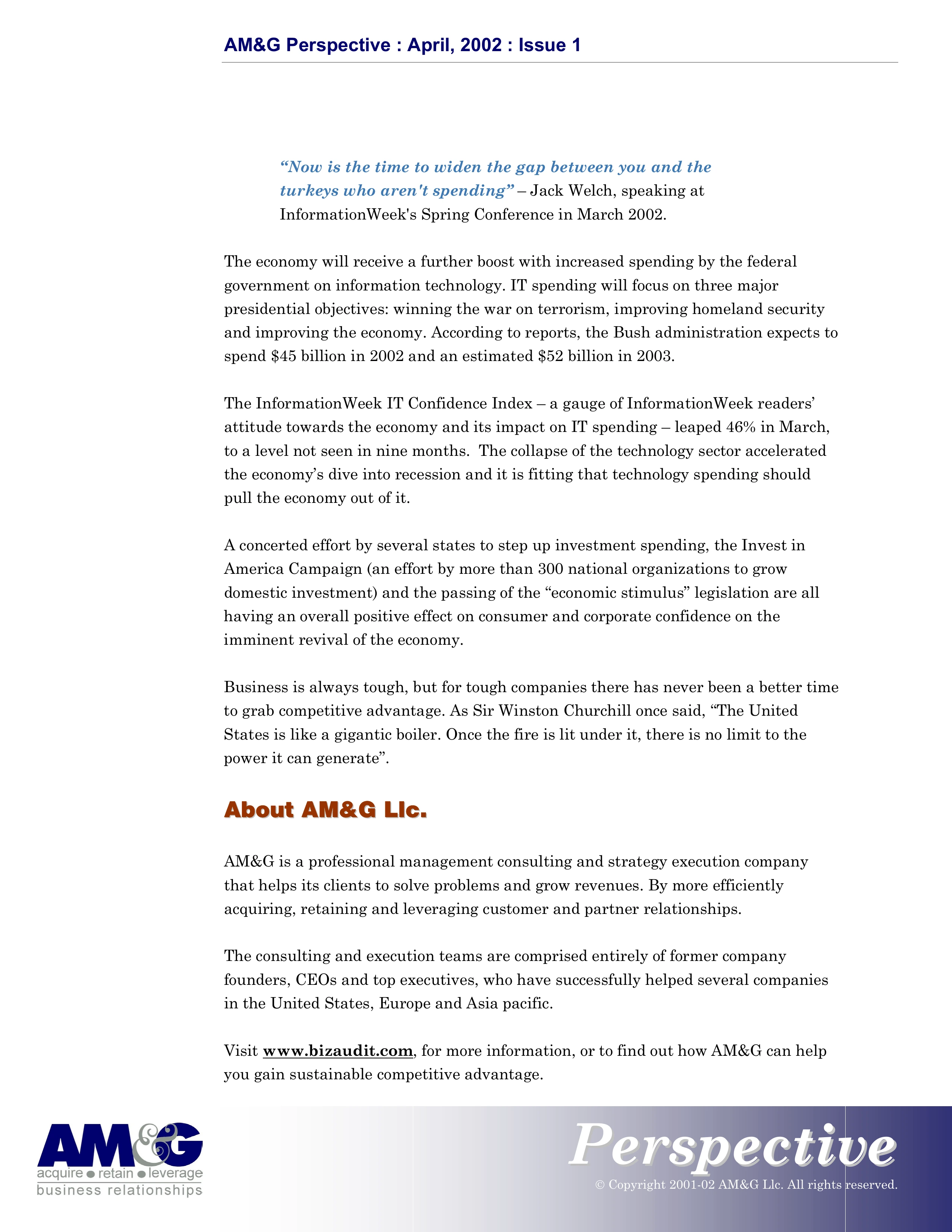
AM&G Perspective · April 2002 · Issue 1. Copyright in the original publication remains with the respective rights holder(s).
Retrospective
Foresight matters when it leads to action
Looking back, the significance of this episode is not simply that we made a call about the direction of the U.S. economy.
The more important part was what followed from it.
Markets, industries and organizations rarely announce their turning points clearly. There is often a period between the underlying change and widespread recognition that the change has occurred.
That gap can create strategic opportunity.
The role of foresight is therefore not simply to anticipate what may happen next. It is to understand what that change means, determine what should be done differently and act while the insight still provides an advantage.
“Foresight identifies the change. Strategic advice turns it into a decision. Execution turns the decision into an outcome.”