
Making Location-Aware Emergency Alerts Work on Feature Phones
A fully automated, multilingual emergency-alert platform built inside the mobile operator network, years before smartphones made location-based services commonplace
In 2011, TBM Technologies' SwAnAlert™ was named a feature-phone finalist in the GSMA mWomen Base of the Pyramid Apps Challenge and featured in the official Global Mobile Awards 2011 publication.
The recognition reflected something more significant than a mobile application. SwAnAlert™ was built around a location-based services platform inside the core mobile operator network, enabling the system to determine the location of a feature phone without requiring GPS, a smartphone or an Internet connection.
When a user needed help, or wanted to tell family and friends that they were safe, the platform could automatically determine the user's location and communicate their status and location to designated contacts through multilingual SMS and multilingual automated voice calls.
The technology moved from concept to large-scale deployment. In India, the service became 55100 on Airtel and Vodafone, and in Sri Lanka 899 on Dialog Axiata. It ultimately served more than 10 million users.
Context
Solving a Problem Before Smartphones Could Solve It
Work on what became SwAnAlert™ began in 2006–2007, when feature phones dominated mobile communications and the capabilities now routinely associated with smartphones were unavailable to most users.
The challenge was not simply to create an emergency-alert application. It was to build the underlying telecommunications infrastructure required to make location-aware emergency communication work on ordinary mobile phones.
We developed a location-based services platform within the core operator network that could identify the location of a user's handset and integrate that information into a fully automated emergency communications process.
A user could signal that help was needed or that they were safe. The system could then automatically notify family and friends, communicating both the user's status and available location information through multilingual SMS and multilingual voice calls.
Because the intelligence resided in the telecommunications network rather than depending on the handset, the service could operate on basic feature phones without GPS or Internet access.
The platform was subsequently deployed commercially by major mobile operators. In India, it operated as 55100 on Airtel and Vodafone; in Sri Lanka, it operated as 899 on Dialog Axiata. Across its deployments, the service reached more than 10 million users.
In 2011, GSMA included TBM Technologies' SwAnAlert™ among the Feature Phone finalists in its mWomen Base of the Pyramid Apps Challenge at the Global Mobile Awards.
The cover of the official Global Mobile Awards 2011 publication and the page featuring TBM Technologies and SwAnAlert™ are reproduced below.

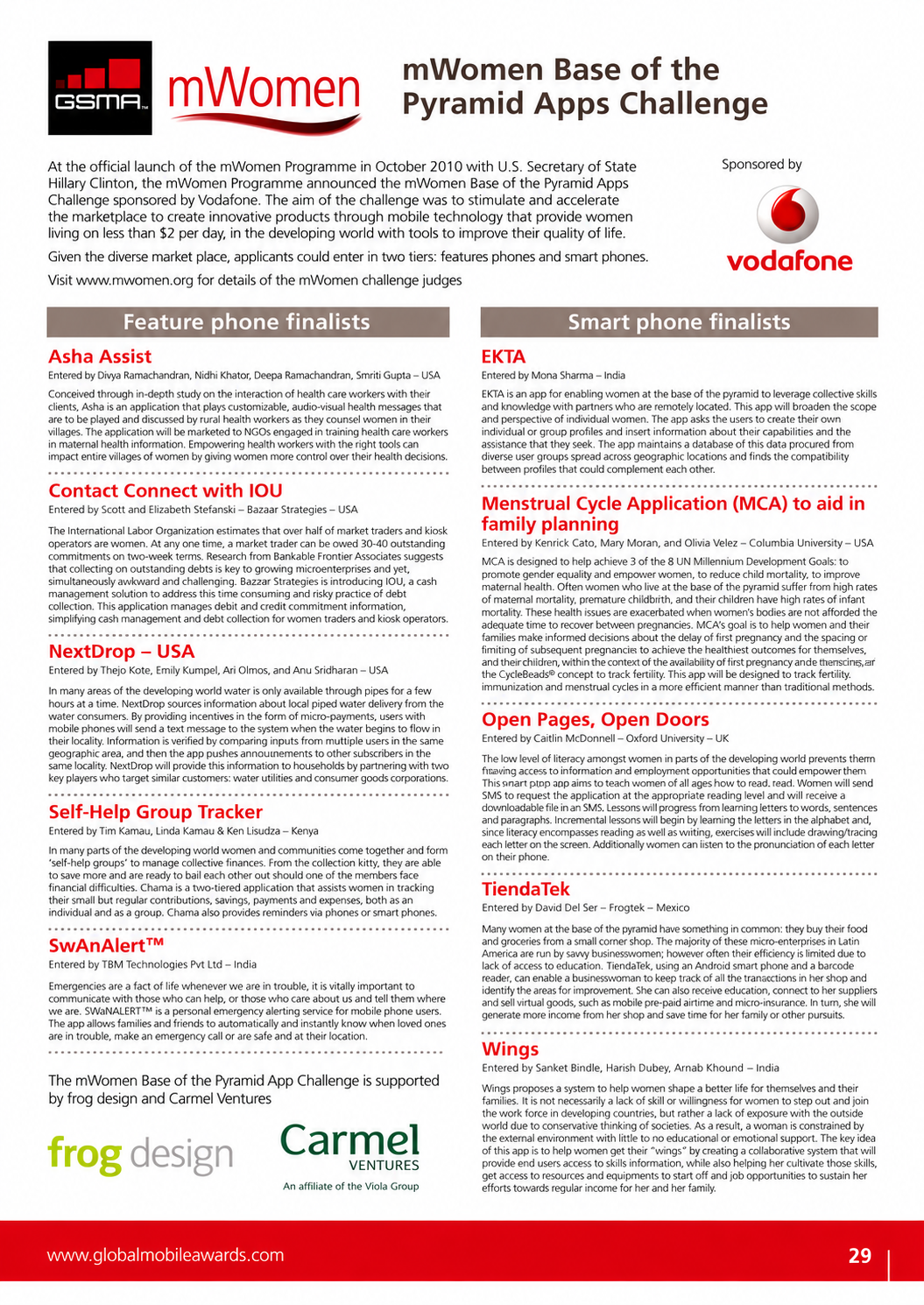
Copyright in the original GSMA documents and reproduced images remains with the respective rights holder(s).
Real-World Impact
From Technology Platform to Lifeline
The value of an emergency communications platform is ultimately measured not by what it can do in a demonstration, but by what happens when people actually need it.
During some of India's worst natural disasters, including those in Uttarakhand, Kashmir and Andhra Pradesh, the platform played a vital role in helping stranded survivors and pilgrims reconnect with their families.
What had begun years earlier as an engineering challenge — determining the location of an ordinary feature phone and automatically communicating that information to others — had become infrastructure capable of helping people during major disasters.
Retrospective
The Innovation Was in the Network, Not the Phone
The architecture solved for the limitations of the handset. Rather than requiring increasingly sophisticated devices, SwAnAlert™ placed critical intelligence within the mobile operator's network. That made location-aware emergency communication possible for people using ordinary feature phones.
Location was only part of the problem. Knowing where someone was had limited value unless that information could immediately reach the people who could act on it. SwAnAlert™ connected location determination directly to a fully automated communications workflow.
The system was designed for accessibility. Multilingual SMS and automated multilingual voice calls meant that emergency communication did not depend on literacy, a data connection, a smartphone application or a particular type of handset.
The technology was built to operate at telecommunications scale. Deployment as 55100 on Airtel and Vodafone and 899 on Dialog Axiata moved the platform beyond a technology concept into live mobile networks, ultimately serving more than 10 million users.
Its value became clearest under real-world conditions. During some of India's worst natural disasters, including those in Uttarakhand, Kashmir and Andhra Pradesh, the platform played a vital role in helping stranded survivors and pilgrims reconnect with their families.
The underlying architecture remains strikingly advanced in concept. Network-based location, automated emergency orchestration, multilingual SMS and voice communication, and the ability to serve people without smartphones, GPS or Internet access remain central ideas in modern emergency communications.
Looking back
Technology Matters When It Works in the Real World
SwAnAlert™ began with a simple question: how do you make advanced emergency communication available when the person who needs it may not have advanced technology in their hands?
Our answer was to move the intelligence into the network.
The result was not simply an application. It became a telecommunications service deployed by major mobile operators and used by more than 10 million people. During some of India's worst natural disasters, including those in Uttarakhand, Kashmir and Andhra Pradesh, it played a vital role in helping stranded survivors and pilgrims reconnect with their families.
Nearly two decades after work on the platform began, the technology surrounding emergency communications has changed enormously. The underlying design principle has not:
When the user's technology is the constraint, can you redesign the system around the constraint rather than accept it?