
The Indian Connection
The new strategic role of country managers as global technology companies entered liberalizing India
The New Role
From liaison office to strategic bridge
The article captured a structural change in India's technology market. Before economic liberalization, many international technology companies had little reason to maintain a significant presence in the country. By the early 1990s, that was changing quickly.
Global companies were beginning to view India as a large, underdeveloped market. Their country managers became responsible for much more than administration: tracking policy and market developments, managing distributors, understanding customers, communicating local realities to headquarters and building the conditions for growth.
Dataquest identified Sanjiv R Mahajan of SPSS as part of the group of country managers who arrived in 1990 as multinational technology companies began establishing stronger positions in India.
Market Representation
An Indian ambassador for a global company
For Mahajan, the role was explicitly two-way. A country manager had to represent the company in India while also representing India inside the company.
“We are like Indian ambassadors for our employers.”
— Sanjiv Mahajan, SPSS · Dataquest, 1993
That idea went beyond public representation. It meant translating the local market for an overseas principal: how customers bought, how distributors operated, where demand was developing and what a global company needed to change to succeed locally.
“My value to SPSS is that I have a good knowledge of the Indian market.”
— Sanjiv Mahajan, SPSS · Dataquest, 1993
Strategy
The job was not simply to sell software
Mahajan described his responsibility in strategic rather than transactional terms:
“My real job is to provide marketing strategy to SPSS.”
— Sanjiv Mahajan, SPSS · Dataquest, 1993
The article placed that responsibility in the context of a fast-changing market. Country managers had to understand political and policy developments, keep their employers informed, work through local partners and still create enough business to justify a growing presence in India.
For SPSS, local market knowledge was being converted into market position. Dataquest reported Mahajan's claim that the company controlled 95 percent of India's data-analysis market at the time.
Channel Strategy
Helping partners succeed
The article also shows an early understanding of channel economics. Multinationals frequently depended on Indian distributors not only for sales, but also for technical input, marketing, training and customer relationships.
Mahajan's view was direct:
“It is in our interest to see that they make money.”
— Sanjiv Mahajan, SPSS · Dataquest, 1993
The principle was simple: a channel could not be treated merely as a route to the customer. Its commercial success was part of the manufacturer's own growth model.
Leadership
Challenge mattered more than title or compensation
Dataquest noted that Mahajan had been heading a small software company in Delhi before being given the opportunity in mid-1990 to head the SPSS office in India.
“SPSS was a great challenge and I think that I have met it successfully.”
— Sanjiv Mahajan, SPSS · Dataquest, 1993
The article later observed that Mahajan would not be motivated by a bigger paycheck but by a bigger challenge. That distinction is consistent with the larger picture presented in the feature: the attraction of the role was the opportunity to build a market, not simply occupy a position.
Retrospective
Global strategy depends on local intelligence
Three decades later, the central issue in the article remains familiar. International expansion succeeds when global scale is combined with people who understand how a local market actually works.
The country manager described here was not merely a sales head or local administrator. The role combined market intelligence, strategy, channel development, customer understanding and communication between two different business environments.
“A global company enters a country. A country leader turns that presence into a market.”
The Original Article
Dataquest · September 1993
The three-page archival feature is reproduced below. The original article identifies Sunjyiev Mahajan by his then-used name, Sanjiv Mahajan, and as the head of SPSS in India.
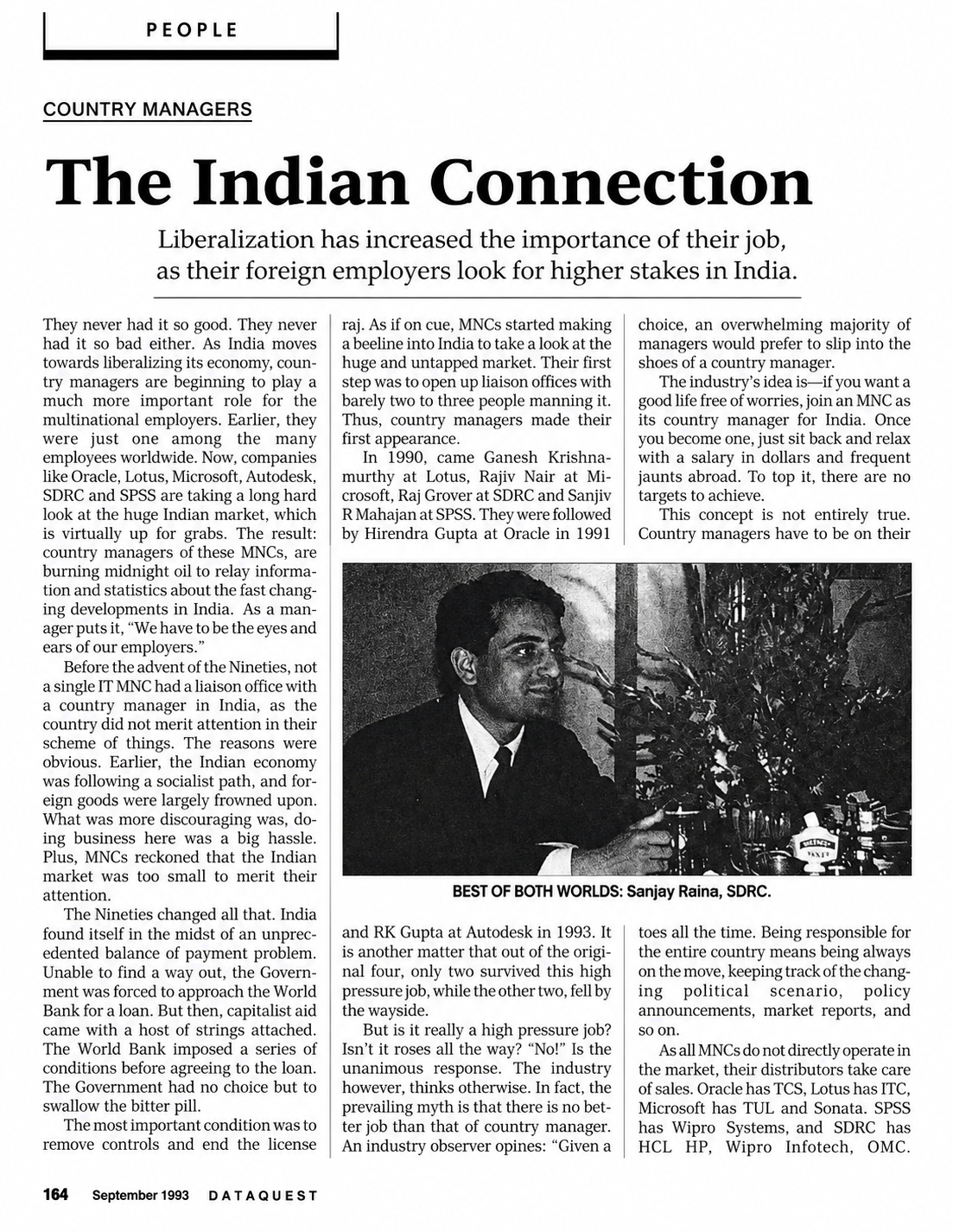
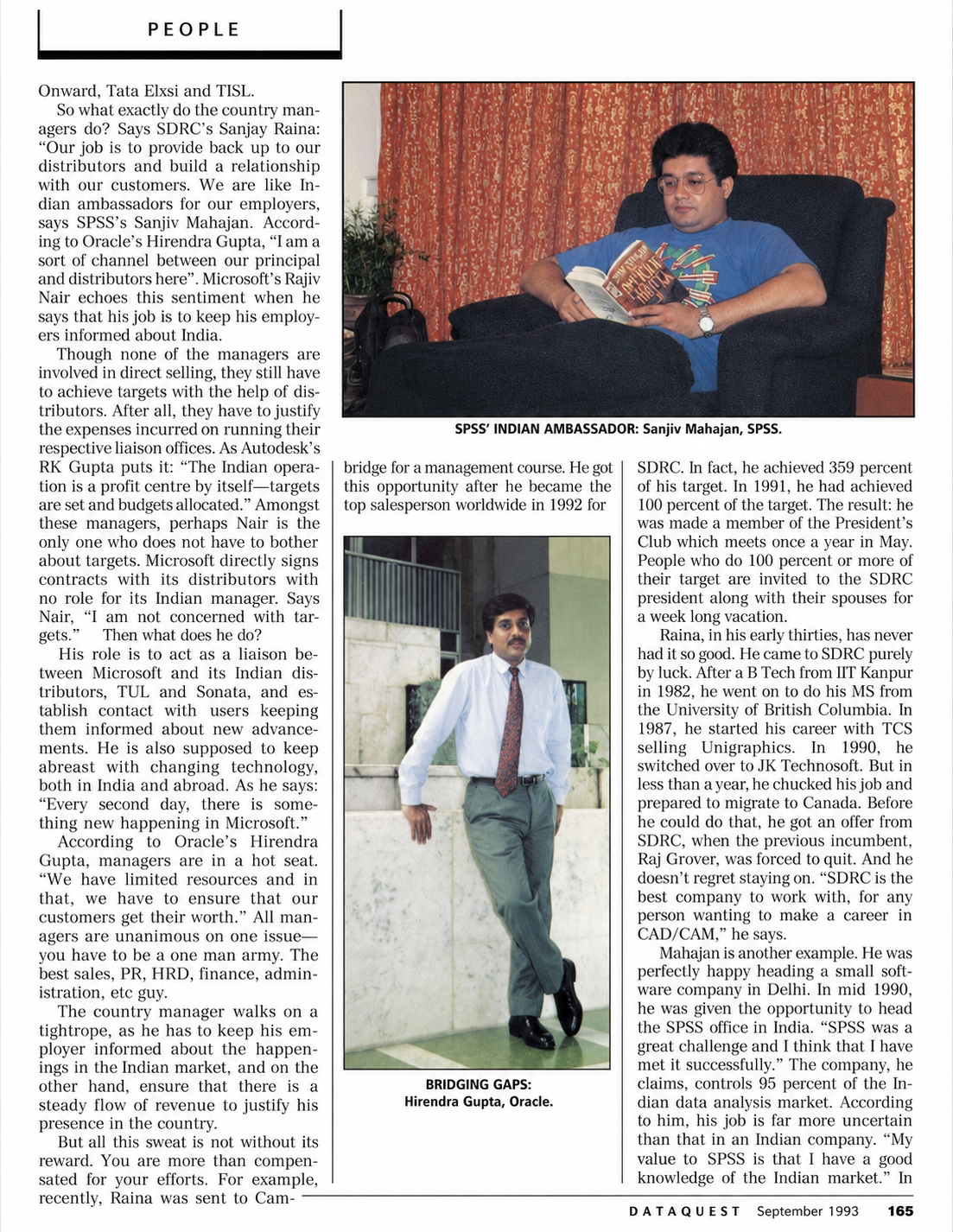

The Dataquest pages are reproduced here as an archival record. Copyright in the original publication and reproduced pages remains with the respective rights holder(s).