
A Suite Of Strategies
How global software companies were adapting products, pricing and go-to-market strategies for India
The Market
A software market moving from experimentation to scale
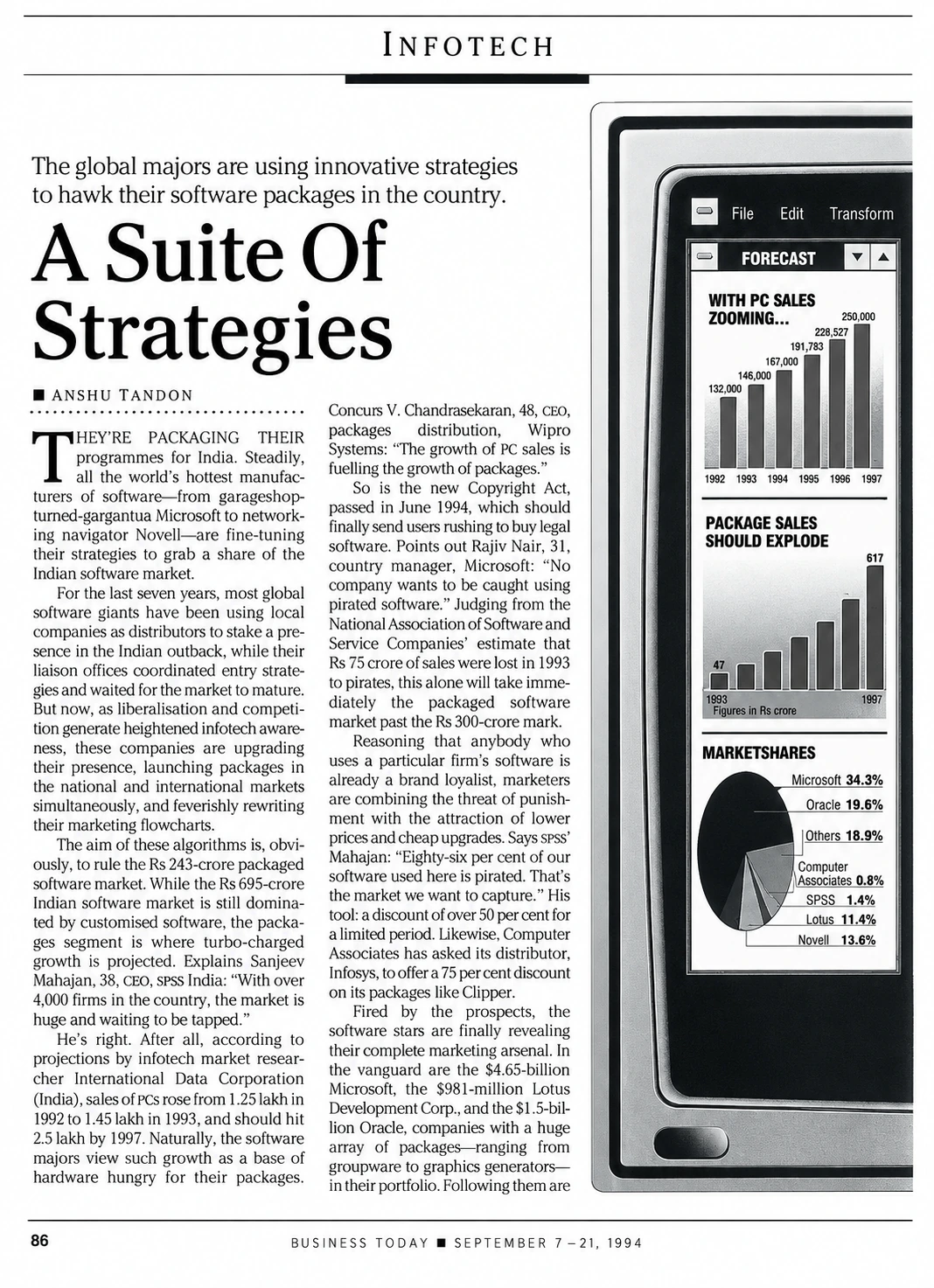
The article described a market in transition. Global software companies that had initially relied largely on local distributors were beginning to establish stronger direct market presence, coordinate India with international launches and rethink their marketing approaches.
Business Today identified packaged applications as one of the fastest-growing parts of the Indian software market and examined how vendors were responding to a market that combined rapid PC growth with substantial software piracy, price sensitivity and relatively low penetration of legal packaged software.
“With over 4,000 firms in the country, the market is huge and waiting to be tapped.”
— Sanjiv Mahajan, CEO, SPSS India · Business Today, 1994
The Strategic Question
Global product, local strategy
The feature showed that success in India required more than importing a global product and reproducing a global sales model.
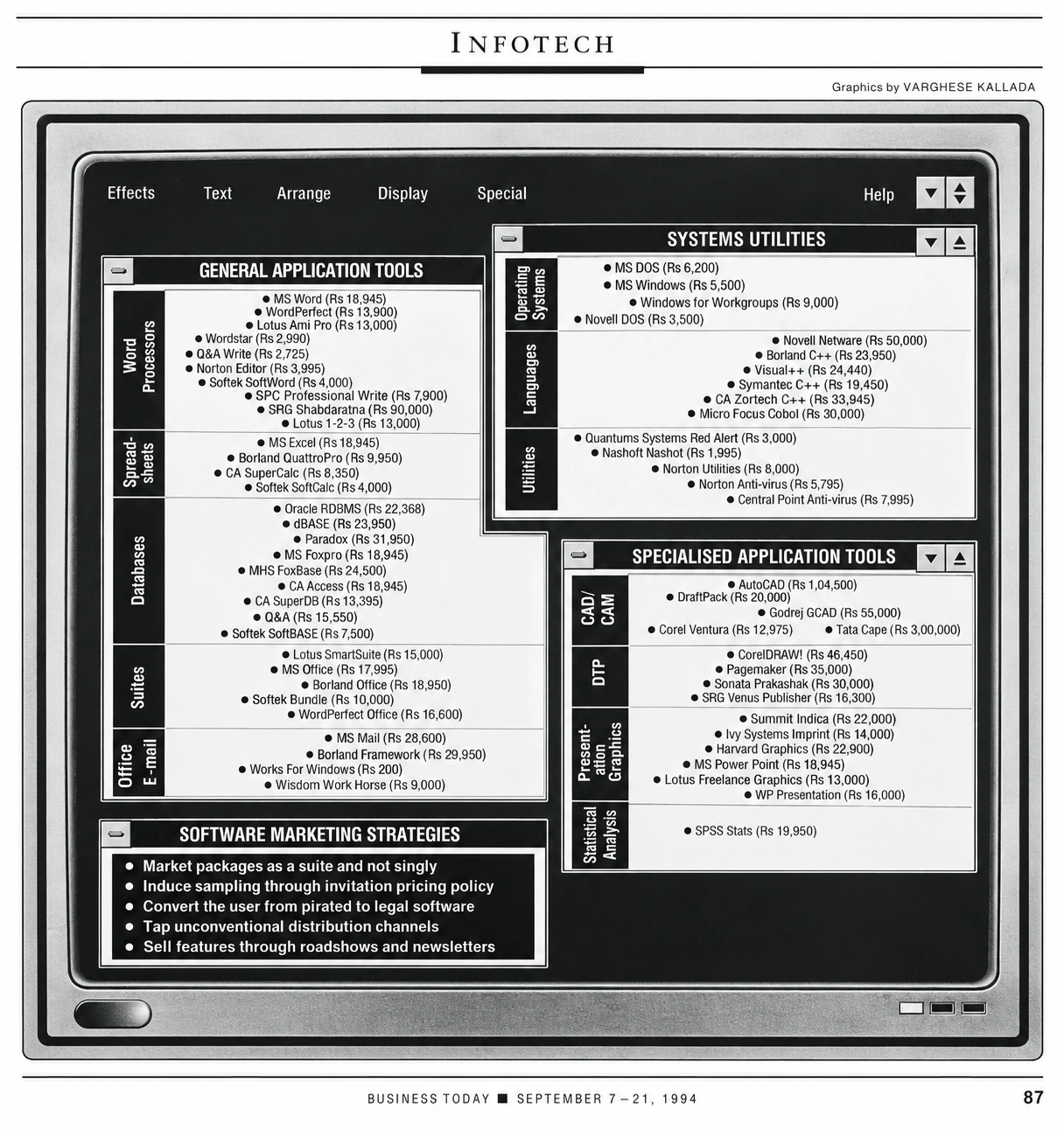
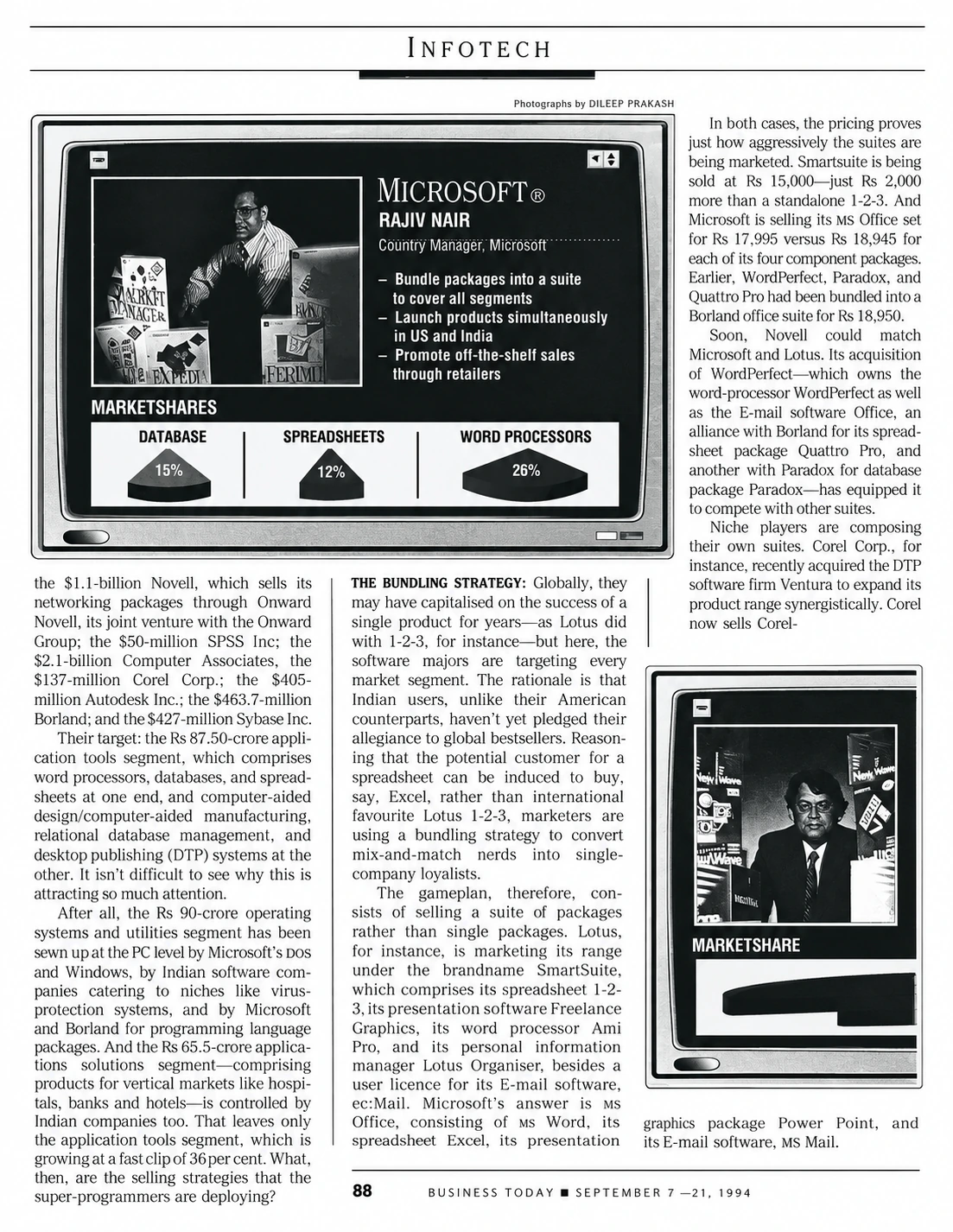
Vendors were experimenting with bundled suites, aggressive invitation pricing, local production, retail channels, dealer networks, user groups, educational pricing, training, support centers and partnerships with hardware manufacturers and systems integrators.
The underlying issue was strategic: how could a global software company lower the barriers to adoption while creating a commercially sustainable market for legal software?
“Eighty-six per cent of our software used here is pirated. That’s the market we want to capture.”
— Sanjiv Mahajan, CEO, SPSS India · Business Today, 1994
SPSS India
Pricing for adoption, then building the market
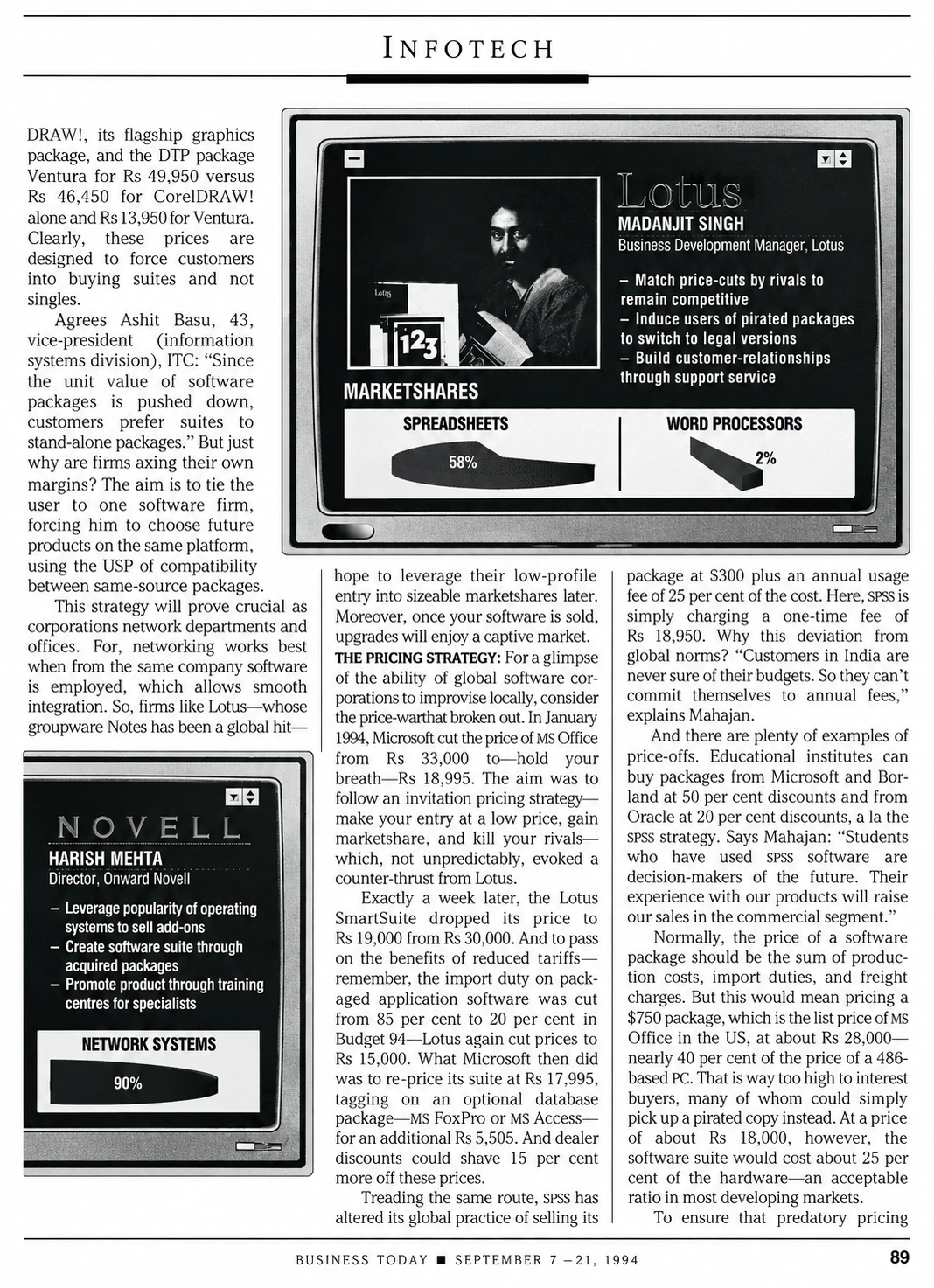
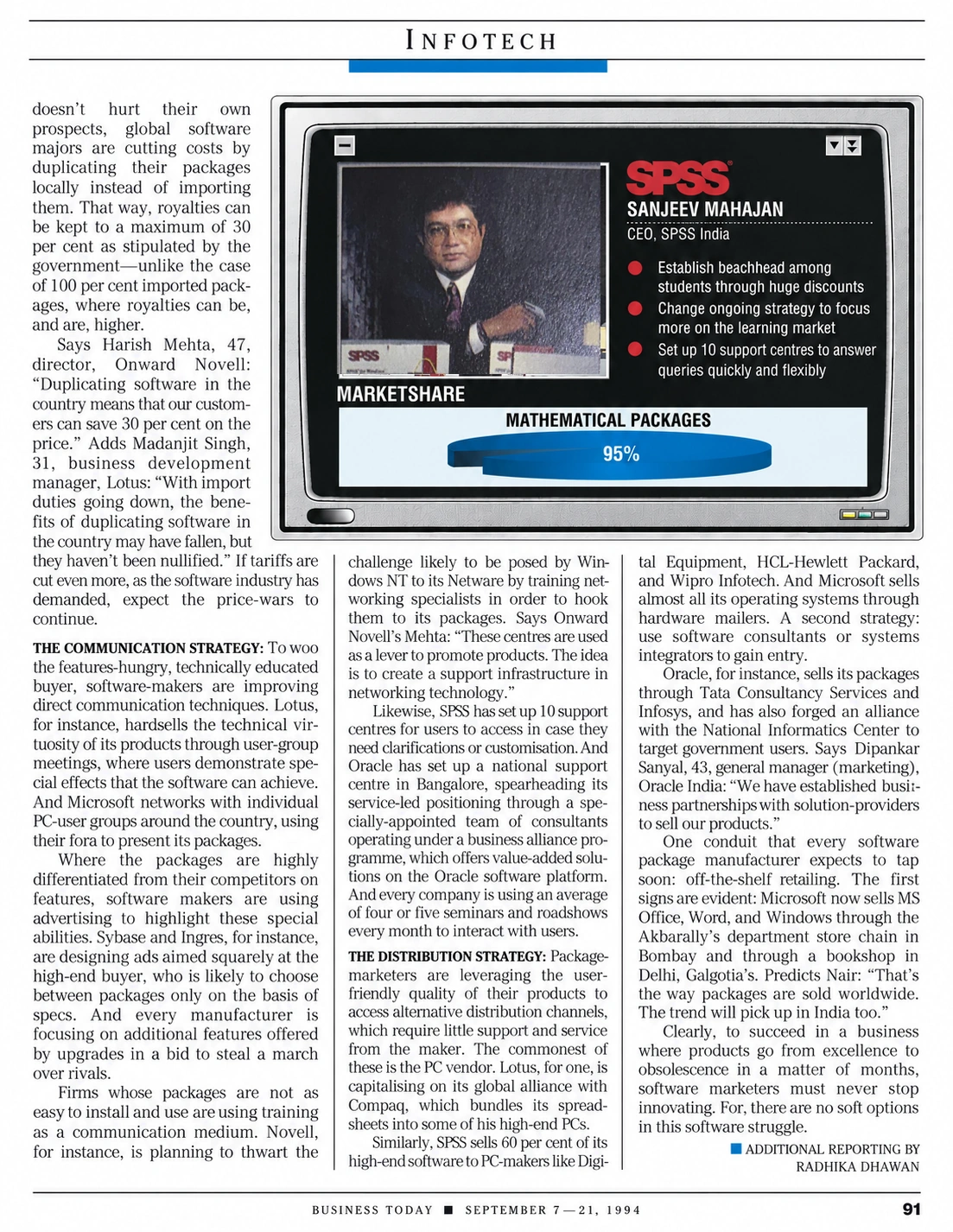
The article featured Sanjiv Mahajan, then CEO of SPSS India, alongside senior executives from Microsoft, Lotus and Novell.
SPSS's approach combined aggressive educational pricing with a longer-term market-development strategy. The logic was that students exposed to SPSS would later become commercial decision-makers, turning early access and familiarity into future demand.
“Students who have used SPSS software are decision-makers of the future. Their experience with our products will raise our sales in the commercial segment.”
— Sanjiv Mahajan, CEO, SPSS India · Business Today, 1994
Mahajan's plan was to seed the market for future customers. By making SPSS accessible to students, while building a network of ten support centers, the company was investing in both future demand and the infrastructure needed to support adoption.
Pricing Strategy
Changing the economics of software adoption
Price was one of the article's central themes. International software companies were discovering that pricing models developed for the United States did not translate automatically to India.
The feature described sharp price reductions, bundled offerings and educational discounts intended to move users from pirated software to legal products, build installed bases and create long-term customer relationships.
SPSS was cited as modifying its global practice of charging a one-time license fee plus annual usage fees. The reasoning attributed to Mahajan was straightforward: Indian customers were often uncertain about future budgets, making recurring annual commitments harder to accept.
Route to Market
Distribution, communication and support became part of the product
The article also showed how software competition was expanding beyond product functionality into the surrounding commercial system.
Vendors were building user groups, training centers, support networks and alternative distribution channels. Hardware manufacturers, systems integrators, retailers and educational institutions increasingly became part of the route to market.
For products that were unfamiliar, technically demanding or expensive relative to local purchasing power, support and education were not peripheral services. They were essential elements of adoption.
Retrospective
Market entry is rarely just a sales problem
Looking back, what stands out is how many of the questions confronting software companies in India in 1994 remain relevant to international expansion today.
A strong product is not enough. Pricing, distribution, customer education, support, partnerships, local economics and buying behavior can determine whether a global offering succeeds in a new market.
The strategic task is to identify which parts of a business model should remain global and which must be redesigned for local conditions.
“Global scale creates opportunity. Local understanding turns it into a market.”
The Original Article
Business Today · September 7–21, 1994
The surviving archival record reproduced below contains five pages from the original feature. One page from the article, page 90, is currently missing from the archive.
Page 90 of the original article is not currently available in this archive.
The Business Today pages are reproduced here as an archival record. Copyright in the original publication and reproduced pages remains with the respective rights holder(s).