
Building Core National Technology Infrastructure for Sri Lanka
A US$100 million technology park designed to attract investment, create employment and strengthen Sri Lanka's technology economy
In January 2006, the Board of Investment of Sri Lanka confirmed my proposal for a US$100 million technology park designed to create the operating environment for technology companies to establish and scale in the country.
The concept went beyond property development, bringing together infrastructure, business facilities and supporting amenities in a plug-and-play environment intended to attract technology-led investment.
Context
A National Opportunity at a Consequential Moment
Sri Lanka was rebuilding after the devastating December 2004 tsunami while seeking new sources of investment, employment and economic growth. The technology park was conceived against that backdrop.
The proposed development was expected to span 100 acres in two phases and support an estimated 10,000 technology-related jobs over five years. Its target sectors included IT and software services outsourcing and life sciences, including computer-based clinical research.
The underlying idea was straightforward: create an environment in which technology companies could arrive, plug in and operate, rather than having to build the surrounding infrastructure themselves.
As Sri Lanka rebuilt, the project's strategic importance led to discussions at the highest levels of government, including with the President and a Cabinet sub-committee of the Council of Ministers.
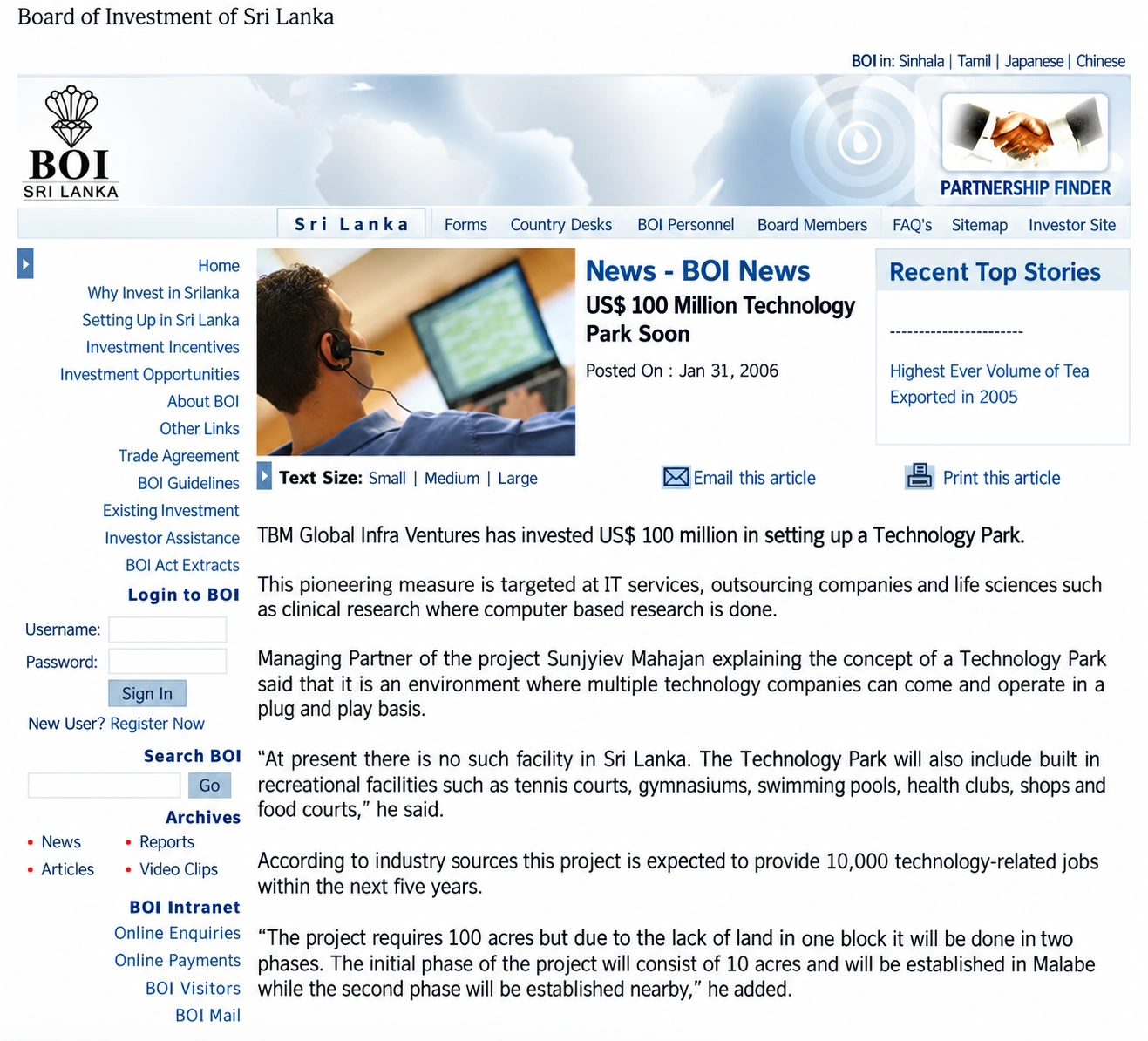
The Board of Investment report provides an official institutional record of my proposal and my description of the technology park concept.
The original BOI report, titled “US$ 100 Million Technology Park Soon,” is reproduced below as posted on January 31, 2006.
Copyright in the original publication and reproduced page remains with the respective rights holder(s).
Retrospective
Core National Infrastructure. More Than Real Estate.
The project was conceived as core national infrastructure. Its significance went well beyond property development, with the objective of creating an environment capable of supporting technology-led investment and economic growth.
The ambition was national in scale. With US$100 million of proposed investment and an estimated 10,000 technology-related jobs over five years, the project represented a significant technology, investment and employment initiative for Sri Lanka.
The model centered on an operating ecosystem. The park was designed around what technology companies needed to establish, operate and grow, combining business infrastructure, supporting facilities and a plug-and-play environment rather than simply providing buildings.
Infrastructure was intended to accelerate investment. By reducing the time and complexity involved in establishing operations, the model sought to make Sri Lanka more competitive as a destination for technology businesses.
The sector strategy was deliberately broad. The park was intended to support IT and software services outsourcing alongside life sciences, including computer-based clinical research, creating complementary sources of investment, employment and technology-led growth.
Looking back
The Operating Environment Matters as Much as the Opportunity
The project reflects an approach that has run through much of my work: identifying an opportunity is only the beginning. The larger challenge is understanding what must exist around it for businesses, technologies and markets to succeed.
In Sri Lanka, that meant thinking beyond individual companies or buildings to the infrastructure, operating environment and ecosystem required to attract investment and support technology-led growth.
The strategic question remains relevant:
What has to exist around an opportunity for it to become commercially viable at scale?